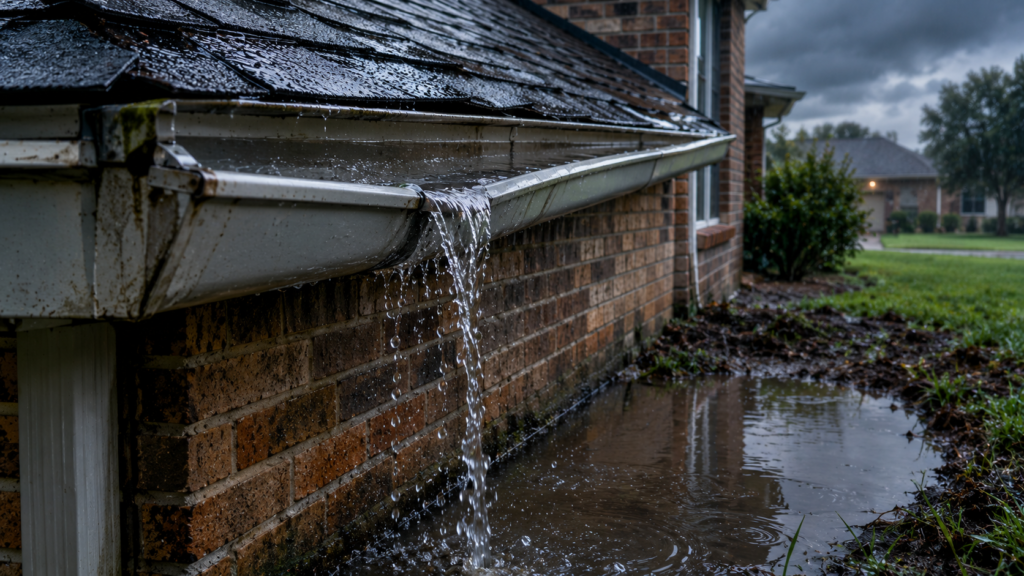
Most homeowners never think about gutter slope until water starts creeping into their basement or crawl space. The truth is, even a perfectly installed gutter system can silently destroy your foundation if the pitch isn’t dialed in correctly.
This isn’t just a gutter problem. It’s a water damage problem. And once foundation pooling begins, the damage compounds fast.
What Is Gutter Pitch (and Why It Matters)?
Gutter pitch refers to the slight downward angle a gutter runs along your roofline directing water toward the downspout rather than letting it sit. The standard recommendation is a ½ inch of slope for every 10 feet of gutter run.
Too little slope and water pools inside the gutter. Too much slope and water overshoots the downspout or causes erosion at the discharge point.
Both extremes lead to the same outcome: water ending up somewhere it shouldn’t usually against your home’s foundation.
5 Gutter Slope Mistakes That Lead to Foundation Water Damage
1. Zero Pitch or Negative Pitch (Backslope)
A gutter installed completely level or worse, sloping away from the downspout holds standing water after every rain event. That water overflows at the low points, soaking into the soil directly alongside your foundation.
Over time, this saturated soil exerts hydrostatic pressure on your foundation walls, leading to cracks, bowing, and eventual water intrusion.
2. Sagging Gutters from Hanger Failure
Even if gutters were installed with proper pitch, hanger failure causes them to sag and create low spots. These low spots become water traps. You’ll notice:
- Streaks of debris buildup along one section
- Overflow during moderate rain (not just heavy storms)
- Rust or staining directly below a section of gutter
Sagging gutters are one of the most overlooked causes of foundation-adjacent pooling because the damage happens gradually.
3. Downspout Discharge Too Close to the Foundation
Even with perfect pitch, where your downspout discharges matters enormously. Industry guidelines recommend downspout extensions that carry water at least 6 feet away from your home’s foundation.
A downspout terminating directly at the base of your home concentrates hundreds of gallons of water per storm into one spot precisely where your foundation is most vulnerable.
According to the Insurance Institute for Business & Home Safety (IBHS), improper drainage and grading issues are among the most preventable causes of residential water intrusion damage.
4. Undersized Gutters on High-Pitch Roofs
A steep roof sheds water faster and in higher volume than a low-slope roof. Homes with steep pitches that still have standard 4-inch gutters are chronically undersized for their actual water load.
During heavy rain, these gutters overflow at the fascia and that water flows straight down the siding and into the soil at the foundation line.
The American Society of Home Inspectors (ASHI) recommends that gutter sizing be matched to roof pitch and square footage, not just treated as a standard item.
5. Incorrect Pitch on Long Gutter Runs
Long gutter runs (over 40 feet) often require a dual-pitch setup sloping from the center outward toward two downspouts. When installed with a single slope on a long run, the far end of the gutter sits too high for adequate drainage, or too low, causing overflow.
Contractors who aren’t experienced with long-run systems frequently miss this, leaving one half of your roofline improperly drained.
How Foundation Pooling Escalates Into Serious Damage
Water pooling near your foundation doesn’t stay contained. Here’s the typical damage sequence:
- Soil saturation – Ground can no longer absorb or redirect water away from the home
- Hydrostatic pressure builds – Saturated soil pushes against foundation walls
- Cracks form – Water finds the path of least resistance into your basement or crawl space
- Mold begins within 24–48 hours – Damp environments are ideal for mold colonization
- Structural compromise – Long-term exposure weakens the foundation itself
By the time homeowners notice water inside the home, the damage is rarely limited to one area. It typically requires professional water damage assessment and remediation not just a gutter fix.
If you’re already seeing signs of water intrusion near your foundation, the gutter issue may be the source, but the interior damage needs professional attention. The team at FloodFix Solutions handles water damage restoration in McAllen, TX and can assess whether your foundation area has sustained moisture damage that needs remediation.
How to Diagnose a Gutter Slope Problem
You don’t need special equipment to spot most pitch issues. Here’s a quick DIY checklist:
- Run a hose test: With someone watching from the ground, run water into the gutter at the far end. It should flow quickly toward the downspout with no standing water visible after 30 seconds.
- Check after rain: Walk the perimeter after a moderate rain. Any section of gutter holding water has a slope or sagging issue.
- Look for overflow streaking: Vertical streaks on your siding or fascia indicate where overflow is consistently happening.
- Inspect downspout discharge: Mark where the downspout ends and measure from the foundation. Less than 6 feet is a risk zone.
- Check for soil erosion or indentation near the foundation: A visible trench or bare patch directly below a downspout is a clear sign of concentrated discharge damage.
Fixes That Actually Solve the Problem
| Problem | Fix |
|---|---|
| Sagging gutters | Replace failed hangers; re-pitch to ½”/10ft |
| Zero-pitch or backslope | Re-hang entire gutter section with correct slope |
| Short downspout extension | Add 6–10 ft rigid or flexible extension |
| Undersized gutters | Upgrade to 5-inch (residential) or 6-inch (steep pitch) gutters |
| Long-run single pitch | Convert to center-peak dual-pitch with two downspouts |
For most homeowners, a combination of re-pitching and adding proper downspout extensions resolves the majority of foundation-adjacent pooling issues without needing to touch the foundation itself.
When Gutter Work Isn’t Enough
If pooling has been happening for more than one season, the damage may already extend beyond what gutter repairs can undo. Signs that professional remediation is needed:
- Visible efflorescence (white mineral deposits) on basement or crawl space walls
- Musty odor in lower levels of the home
- Staining or discoloration at the base of foundation walls
- Soft or crumbling drywall in below-grade rooms
These are indicators of moisture intrusion that requires more than surface-level fixes.
The Bottom Line
Gutter pitch isn’t a cosmetic detail it’s a drainage engineering decision that directly affects your foundation’s long-term health. A slope error of even a few degrees compounds over thousands of gallons of rainwater per year, creating exactly the saturated soil conditions that crack foundations and invite water damage.| ClearFlow Gutters
Fix the pitch. Extend the downspouts. And if water has already made it inside, don’t wait to address the remediation side.
Also see: What Happens Inside Your Walls When Gutters Overflow for Years
Leave a Reply