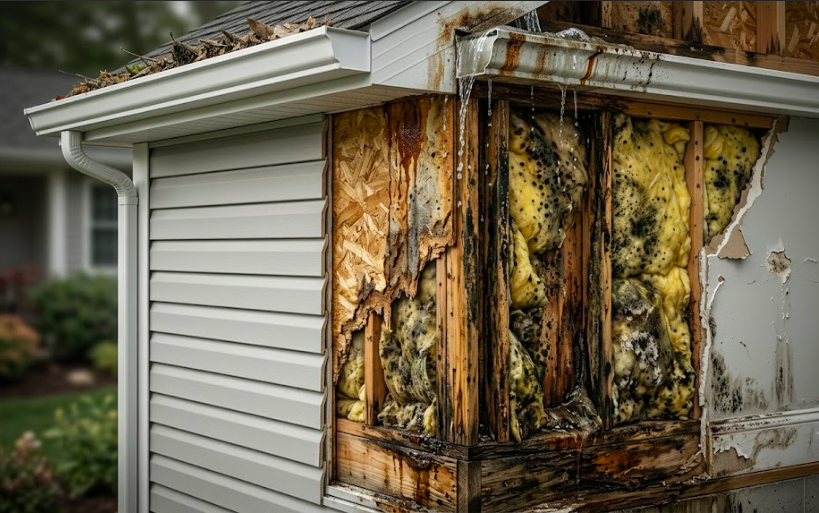
Most homeowners never think about their gutters until they absolutely have to. And by that point, the damage has already been happening for months, sometimes years, completely hidden from view. When gutters overflow repeatedly, rainwater doesn’t just run down the side of your house. It finds a path inward through your siding, into your wall cavity, and deep into the structural materials that hold your home together.
This article walks you through exactly what happens inside your walls during prolonged gutter overflow, stage by stage. The reality is more serious and more expensive than most homeowners expect.
How Gutter Overflow Gets Behind Your Walls
When a gutter is clogged, damaged, or improperly pitched, water pools along the roofline instead of channeling away. That pooled water has only a few places to go:
- Fascia boards: The wooden board directly behind your gutter absorbs overflow first. Once saturated, rot sets in within weeks.
- Soffit venting: Water running over fascia seeps into soffit panels, entering the attic or wall cavity through ventilation gaps.
- Siding seams: Even vinyl and fiber cement siding has seams. Sustained moisture pressure forces water behind the panels.
- Window and door headers: Overflow that runs along exterior walls concentrates at horizontal breaks especially above windows and doors.
Once water is behind the exterior envelope, it doesn’t drain. It sits and it works.
The Hidden Damage Timeline: Stage by Stage
Stage 1 – Months 1 to 3: Moisture Saturation
In the first few months of repeated overflow, wall insulation absorbs moisture like a sponge. Fiberglass batts and cellulose insulation lose their R-value when wet, meaning your home simultaneously becomes more expensive to heat and cool and you won’t know why.
The wall framing (typically 2×4 or 2×6 studs) begins absorbing moisture at this stage. Wood will tolerate brief wetness, but sustained moisture content above 19% creates the conditions for fungal growth. At this stage, there are no visible signs on your interior drywall.
Stage 2 – Months 3 to 8: Mold Colonization
Mold spores are present in virtually every home. All they need to colonize is a surface with moisture and an organic food source both of which your wall cavity now provides. According to the EPA, mold can begin growing on wet surfaces in as little as 24 to 48 hours under the right conditions.
Inside a wall cavity, mold typically colonizes:
- The paper facing on drywall (interior side)
- The OSB or plywood wall sheathing (exterior side)
- Wood stud faces and edges
- Any cellulose-based insulation
At this stage, homeowners may notice a musty smell in specific rooms, allergy flares with no obvious cause, or small discoloration patches near baseboards or window frames. Many attribute these signs to seasonal allergies or humidity not to their gutters.
Stage 3 – Months 8 to 18: Structural Wood Rot
By the time gutter overflow has been ongoing for a year or more, the damage shifts from a moisture problem to a structural integrity problem. Wood rot both white rot (which breaks down cellulose) and brown rot (which destroys lignin) begins compromising the load-bearing capacity of wall framing.
Rotted studs cannot be dried out and restored. They must be cut out and replaced a process that requires opening finished wall surfaces. This stage of repair typically costs between $2,000 and $8,000 per affected wall section, depending on the extent of framing damage and whether the damage has spread to floor joists or roof sheathing.
Stage 4 – 18+ Months: Foundation and Subfloor Damage
In severe or long-term cases, the water pathway extends downward from the wall cavity into the floor assembly. Subfloor OSB swells, delaminates, and eventually crumbles under foot traffic. In homes with crawl spaces, overflow that runs down exterior walls often finds its way under the foundation, contributing to soil erosion, pier settlement, and crawl space moisture accumulation.
At this stage, the repair scope is no longer limited to gutters or even walls it involves full-scale water damage restoration that addresses not just cosmetic surfaces but the structural systems beneath them. For homeowners in northeast Ohio, where freeze-thaw cycles accelerate this timeline significantly, the window between early moisture intrusion and serious structural damage is often shorter than in warmer climates.
Warning Signs You Should Never Ignore
If your gutters have been overflowing even occasionally look for these indicators of hidden wall damage:
- Bubbling or peeling interior paint: Moisture vapor pushing through drywall causes paint to lose adhesion.
- Soft or spongy drywall near roofline: Press gently above windows or near ceiling corners. Healthy drywall is firm.
- Visible staining on ceilings or upper walls: Brown or yellow ring stains indicate water has already traveled through the assembly.
- Increased heating/cooling costs: Wet insulation performs significantly worse than dry insulation.
- Musty odor in one specific room: Localized smells often indicate contained mold growth inside a wall cavity.
- Exterior siding that feels hollow or soft: Siding that flexes under hand pressure has lost its backing substrate.
What Professional Assessment and Remediation Actually Involves
When water damage has progressed beyond the early stages, the remediation process follows the IICRC S500 Standard the industry benchmark for professional water damage restoration. A certified remediation team will:
- Use thermal imaging cameras and moisture meters to map the full extent of moisture inside wall cavities no guessing, no tearing walls open unnecessarily
- Classify the water damage category (Category 1 clean water through Category 3 grossly contaminated water)
- Deploy commercial-grade dehumidifiers and air movers in a calculated drying configuration
- Remove and dispose of materials that cannot be dried (wet insulation, moldy drywall, rotted OSB)
- Apply EPA-registered antimicrobial treatments to all affected surfaces before closing the wall
- Provide a drying log and clearance documentation for insurance purposes
For homeowners in the Akron area dealing with the aftermath of chronic gutter overflow, reaching out to a certified water damage restoration in Akron team early before mold testing or structural repairs are quoted can significantly reduce the total cost of recovery. Many remediation companies offer free assessments with moisture mapping included.
Preventing This From Happening: Gutter Maintenance That Actually Works
The good news: virtually all of this damage is preventable. The bad news: prevention requires consistent attention, not just a one-time fix. Here’s what a sound gutter maintenance protocol looks like:
- Clean gutters twice yearly at minimum: Once in late spring (after tree flowering) and once in late fall (after leaf drop). In areas with heavy tree cover, quarterly cleaning is appropriate.
- Check and reset gutter pitch: Gutters should slope ¼ inch per 10 feet toward downspouts. A level gutter pools water and will overflow in heavy rain regardless of how clean it is.
- Inspect end caps and seams after every major storm: These are the first failure points in aluminum sectional gutters.
- Ensure downspouts extend at least 6 feet from the foundation: The most common gutter mistake is a downspout that terminates at grade level right next to the foundation.
- Consider seamless gutter replacement for aging systems: Sectional gutters more than 15 years old have typically exceeded their useful life. Seamless gutters eliminate the seam failures that cause the majority of overflow events.
If your gutters are overdue for inspection, repair, or replacement, professional gutter repair is the logical first step and the most cost-effective way to prevent the wall damage described in this article from reaching your home.
The Bottom Line: When to Act and Who to Call
Gutter overflow is not a cosmetic problem. It is a slow-moving structural emergency that compounds with every rain event. The wall damage it causes insulation loss, mold growth, wood rot, foundation moisture does not resolve on its own, and it does not stay contained. Water always finds more material to damage.
If you’ve been dealing with overflowing gutters for more than one season, the responsible next step is a two-part action: first, fix the gutters to stop the water source; second, have your walls assessed by a certified water damage professional to determine what has already been compromised. Catching mold at Stage 2 costs a fraction of what Stage 3 structural remediation costs.
Don’t wait for visible signs. By the time you see staining or smell mold, the damage inside your walls is typically already extensive. Act on what you know about your gutters, not on what you can see from inside your home.
For guidance on home water damage safety during remediation, the American Red Cross water damage resources provide a reliable overview of health precautions and what to expect during professional remediation.
Leave a Reply