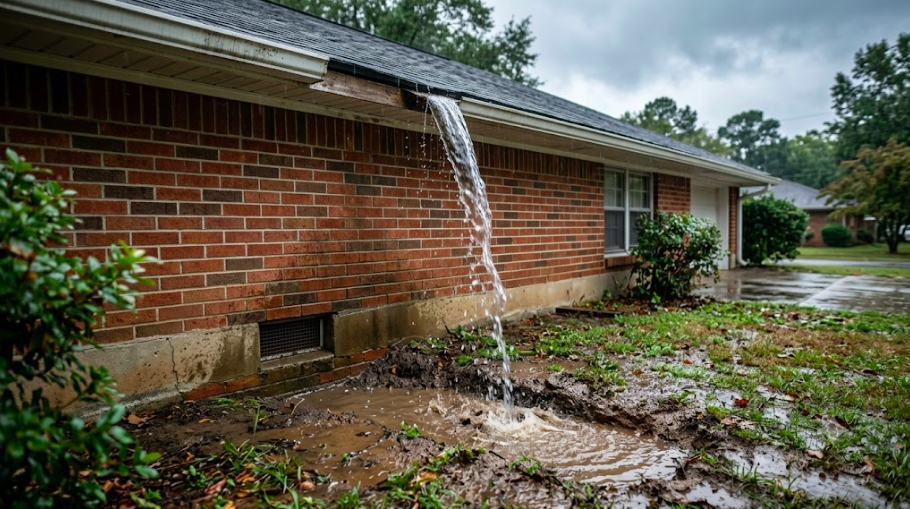
Short answer: Yes. A missing gutter section lets roof runoff spill straight down beside your foundation instead of traveling to a downspout. That concentrated water saturates the soil, then finds its way through vents, cracks, and gaps into your crawl space. It rarely looks like a dramatic flood. It’s usually a slow moisture problem that does serious damage before anyone notices.
How Much Water Are We Talking About?
A roof sheds far more water than most homeowners expect. One inch of rain on a 1,000-square-foot roof produces roughly 620 gallons of runoff. Gutters exist to collect that volume and carry it away from the house.
When a section is missing, cracked, or sagging, the water that would have been guided to the downspout drops from the roofline in one spot instead. Over a single storm, that can mean hundreds of gallons landing against the same few feet of foundation.
How Missing Gutter Sections Lead to Crawl Space Flooding
1. Soil saturation at the foundation: Concentrated runoff soaks the ground right next to the home. Saturated soil pushes moisture toward the foundation wall and the crawl space below.
2. Soil erosion and negative grading: Falling water digs a trench or washes soil away, which flattens or reverses the slope that should direct water away from the house. Future rain then pools against the foundation.
3. Hydrostatic pressure: Waterlogged soil exerts pressure on foundation walls. Water follows the path of least resistance: hairline cracks, mortar joints, vent openings, and utility penetrations.
4. Standing water and persistent humidity: Once water enters, most crawl spaces have nowhere to send it. Even without visible puddles, the air stays damp for weeks.
What Happens When a Crawl Space Stays Wet
The U.S. EPA’s guidance on moisture and mold is clear that controlling moisture is the key to controlling mold. A damp crawl space creates exactly the conditions mold needs.
- Mold and mildew growth on joists, subfloor, and insulation
- Wood rot that weakens floor framing over time
- Pest activity, since termites, rodents, and insects favor damp, hidden areas
- Musty indoor odors, because crawl space air moves upward into living areas
- Ruined insulation and ductwork, which raises energy costs
- Foundation settlement or movement from repeated wetting and drying of soil
The U.S. Department of Energy also notes that crawl space moisture control directly affects home comfort and efficiency, which is why drainage should be addressed before any insulation or encapsulation work.
Warning Signs Your Gutters Are Already Affecting the Crawl Space
Check for these after the next rain:
- A gap, disconnected seam, or fallen gutter section along the roofline
- Water spilling over the edge of the roof where the gutter should be
- Soil erosion, a small trench, or exposed foundation below the missing section
- Pooling water or soggy ground near the foundation 24 hours after rain
- Stains, efflorescence (white mineral residue), or dampness on foundation walls
- Musty smells inside the home, especially near floors
- Sagging or soft spots in flooring above the crawl space
- Visible mold or condensation when you inspect the crawl space
What to Do Right Now
- Document it: Photograph the missing section and any soil erosion or staining.
- Redirect water temporarily: A downspout extension or splash block can reduce the immediate impact while repairs are arranged.
- Inspect the crawl space safely: Look for standing water, damp insulation, or mold. If you see more than a small area of growth, don’t disturb it.
- Repair or replace the gutter section: This is the cheapest part of the fix and the one that stops the source.
- Correct the grading: The soil should slope away from the foundation, roughly 6 inches over the first 10 feet.
- Extend downspout: at least 4 to 6 feet from the home.
When Water Has Already Reached the Crawl Space
Fixing the gutter stops new water, but it doesn’t remove moisture that’s already inside. If you find standing water, wet insulation, persistent humidity, or mold, the structure needs to be dried properly and quickly. Mold can begin developing within 24 to 48 hours of sustained moisture.
For homeowners in South Texas, where heavy tropical downpours and humid air make crawl spaces slow to dry, a professional water damage restoration in McAllen, TX team can extract water, run drying equipment, and check for hidden moisture before it turns into rot or mold.
How to Prevent This Problem Long-Term
- Inspect gutters twice a year and after major storms
- Clear debris so water doesn’t back up and overflow
- Re-secure loose hangers and sagging runs promptly
- Replace cracked or missing sections instead of patching repeatedly
- Make sure every downspout discharges away from the foundation
- Keep crawl space vents clear and consider a vapor barrier
- Check the soil grade each year, since it settles over time
Frequently Asked Questions
Can one missing gutter section really cause crawl space flooding?
Yes. Even a short gap can release large volumes of water in one spot, and repeated storms can saturate soil enough to push moisture into the crawl space.
How fast can a crawl space develop mold after a gutter failure?
Mold can start within 1 to 2 days of continuous moisture. In poorly ventilated crawl spaces it often spreads unseen.
Is a missing gutter section an emergency?
It’s urgent, though not always an emergency. Repair it before the next significant rain. If water is already in the crawl space, treat it as time-sensitive.
Will my homeowners insurance cover the damage?
Coverage varies by policy and cause. Gradual damage from poor maintenance is often excluded, so documenting the problem and acting early matters. Check with your insurer.
Should I fix the gutter or the crawl space first?
Stop the source first, then dry and repair the crawl space. Otherwise the new water undoes the work.
Final Thoughts
A missing gutter section looks minor from the driveway, but it can quietly send hundreds of gallons into your foundation each storm. Fixing it early costs a fraction of what mold remediation, structural repair, or crawl space restoration will cost later.
If your gutters are damaged, sagging, or missing sections, schedule a professional inspection and repair with the team at Clearwater Gutter Repair before the next storm.
Leave a Reply