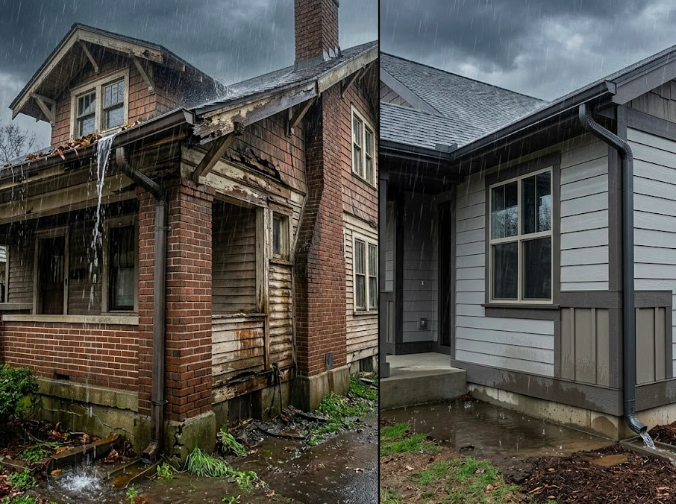
Gutters seem simple they catch rainwater and move it away from your home. But the way water damage develops from gutter failures looks very different depending on whether your home was built decades ago or just a few years back. The materials, the construction standards, and the vulnerabilities are not the same.
If you’re a homeowner, landlord, or property manager trying to stay ahead of gutter-related water damage, understanding these differences can save you thousands in repairs.
Why Home Age Changes the Entire Gutter Water Damage Equation
It’s not just about old gutters looking worn. The issue goes deeper into framing, foundation design, drainage slopes, and what materials were considered “standard” at the time of construction.
Older homes were built under different codes, with different material assumptions, and for different rainfall load expectations. New construction benefits from tighter tolerances, modern materials, and updated drainage standards but that doesn’t make them immune.
Both property types fail. They just fail in different ways.
Older Homes: Where Gutter Water Damage Runs Deep
1. Deteriorated Fascia and Soffit – The Hidden Cost of Age
In homes built before the 1980s, fascia boards were typically made of solid wood. Decades of moisture exposure from rain, snowmelt, and standing water in sagging gutters cause these boards to rot from behind, where it’s invisible until structural failure begins.
By the time a homeowner notices peeling paint or a sagging gutter, the rot has often spread into the soffit and even the rafter tails underneath the roofline. This isn’t cosmetic damage. It’s a structural repair job.
Key signs to watch for in older homes:
- Gutters pulling away from the roofline
- Soft spots or discoloration on fascia boards
- Staining inside the attic near the eaves
2. Original Drainage Slopes May No Longer Be Effective
Homes settle over decades. Even if the gutters were installed with the correct pitch toward downspouts, foundation movement and wood shrinkage can subtly alter that slope over time.
A gutter that drains effectively at 1/4 inch per 10 feet the standard recommendation may now be running at flat or even a reverse slope. Water pools, overflows at the wrong end, and seeps behind the fascia or down the exterior walls.
3. Lead-Based Paint and Older Sealant Materials
Older homes repaired with lead-based paint around gutter seams and brackets have a compounding problem as the lead paint deteriorates, it exposes underlying wood and metal to moisture penetration. Caulk and sealants used before modern silicone formulations also break down faster, leaving open seams in gutter joints.
4. Basements Without Modern Vapor Barriers
Many homes built before the 1970s have unfinished basements with no vapor barrier or with barriers that are decades past their lifespan. When gutter overflow saturates the soil next to the foundation, that moisture migrates inward through block or poured concrete walls with little resistance.
This is where gutter failures in older homes often escalate to serious interior water damage not just a damp crawl space, but active water intrusion, efflorescence on walls, and mold inside the home’s lowest level.
When gutter water damage reaches your foundation, basement, or crawl space, it goes beyond what a gutter repair can fix. The restoration side of this – drying, mold remediation, structural repairs requires a certified water damage professional. If you’re dealing with active flooding or moisture damage in South Texas, the team at FloodFix Solutions in McAllen handles emergency water damage restoration and can assess the full extent of the problem.
5. Galvanized Steel Gutters at End of Life
The standard gutter material for most of the 20th century was galvanized steel. While durable initially, galvanized gutters have a lifespan of roughly 20–30 years. Many older homes are running on original or once-replaced gutters that are now well past that window.
Rust, pinhole leaks, and failed seam solder joints allow water to drip directly onto fascia boards and down exterior walls often for years before anyone notices. According to the Insurance Information Institute, gradual water damage from this kind of slow leak is frequently excluded from standard homeowners insurance policies making early identification critical.
New Construction: Different Materials, Different Failure Points
New homes look clean and modern, but they carry their own set of gutter water damage vulnerabilities many of which homeowners don’t expect.
1. Improper Installation Is the #1 New Construction Risk
Unlike older homes where wear and tear is the primary culprit, new construction water damage from gutters is most often caused by installation errors. These include:
- Insufficient slope – Gutters pitched too flat or improperly aligned during the build
- Undersized downspouts – Builders cutting costs with smaller-diameter downspouts that can’t handle regional rainfall loads
- Incorrect hanger spacing – Hangers placed too far apart (more than 24–36 inches) allow gutters to sag and pool under heavy rain
These errors are invisible at first. They only show up after the first major rain event or after the builder’s warranty has expired.
2. Engineered Wood and OSB Sheeting Are Highly Moisture-Sensitive
Modern homes frequently use OSB (Oriented Strand Board) for roof decking and wall sheathing. OSB is cost-effective and structurally sound, but it is significantly more susceptible to moisture swelling and delamination than the solid lumber used in older homes.
A gutter that overflows or backs up near a roof valley can quickly saturate OSB roof decking. Once this material gets wet and dries multiple times, it loses its structural integrity and can require full replacement at much higher cost than equivalent damage to solid wood.
The National Roofing Contractors Association (NRCA) notes that moisture infiltration at roof edges is among the most common and most preventable causes of premature roofing failure in residential construction.
3. Vinyl and Aluminum Gutters: Lightweight, But Expansion-Prone
Nearly all new construction uses seamless aluminum or vinyl gutters. These are lightweight, rust-proof, and low maintenance but they expand and contract significantly with temperature changes.
In climates with wide temperature swings, this thermal movement can work fasteners loose over time, pull caulk seams apart at end caps, and create gaps at gutter joints. Once a seam separates, water drips behind the gutter and directly onto the fascia which in new construction is almost always primed composite or engineered wood trim, not solid lumber.
Composite trim holds up better to short-term moisture than old-growth wood, but prolonged wetting from a dripping seam will cause it to swell, delaminate, and eventually require replacement.
4. Concrete Slab Foundations React Differently Than Block Basements
Most new homes in Sun Belt and Southern markets (including Texas) are built on concrete slab foundations rather than full basements. This changes how gutter overflow affects the structure.
With a slab foundation, overflow water doesn’t fill a basement. Instead, it saturates the soil immediately adjacent to the slab, which can cause:
- Hydrostatic pressure on the slab edges
- Soil erosion under the slab, leading to settlement and cracking
- Moisture intrusion through the slab-to-wall connection point
This is a slower process than basement flooding, but the outcome cracked slabs, shifting foundations, and water entering living space through floor joints can be just as costly.
5. Landscaping and Grading Issues Are Common in New Developments
New subdivisions often have grading problems for the first several years after construction soil settles, mulch berms flatten, and drainage patterns shift. In many new builds, the final grading doesn’t properly slope away from the foundation at the recommended 6 inches of drop per 10 feet.
When gutters overflow or downspouts terminate too close to the home (less than 4–6 feet from the foundation), water collects in the negative-grade zones and works toward the slab or crawl space vent.
Side-by-Side Comparison: Older Homes vs. New Construction
| Factor | Older Homes | New Construction |
|---|---|---|
| Primary gutter material | Galvanized steel, cast iron | Seamless aluminum, vinyl |
| Fascia/soffit material | Solid wood (rot-prone) | Composite/engineered trim |
| Main failure cause | Age, corrosion, settlement | Installation errors, thermal expansion |
| Foundation type | Block basement, stone | Concrete slab |
| Water damage pathway | Behind fascia → basement | Behind fascia → slab edge |
| Structural backup material | Solid lumber (more moisture-tolerant) | OSB (swells and delaminates faster) |
| Insurance considerations | Gradual damage often excluded | Sudden damage may be covered |
| Early warning visibility | Usually visible (rust, rot) | Often hidden until major damage |
What Both Property Types Have in Common
Regardless of when your home was built, gutter water damage follows the same progression if left unaddressed:
- Overflow or leakage at the gutter line
- Water reaches fascia, soffit, or siding
- Moisture penetrates to the wall cavity or foundation perimeter
- Mold begins developing within 24–48 hours of sustained moisture
- Structural degradation begins progressively more expensive to reverse
The difference is where in that chain each property type is most vulnerable. Older homes tend to present earlier warning signs (visible rust, sagging, peeling paint). New construction failures often go undetected longer, leading to more advanced damage by the time they’re caught.
Prevention Checklist: Protecting Your Home by Age
Older Homes (15+ years)
- Inspect fascia boards behind gutters annually press for soft spots
- Check gutter pitch with a level; reset hangers if slope has reversed
- Replace galvanized gutters showing rust or pinhole corrosion
- Repoint or re-caulk all gutter joints and end caps
- Confirm downspout extensions are directing water 4–6 feet from the foundation
- Inspect basement walls for efflorescence, staining, or active seepage after heavy rain
New Construction (under 15 years)
- Verify installer’s hanger spacing is within 24–36 inches
- Confirm downspout sizing matches regional rainfall expectations
- Check gutter pitch with a level especially at corners and valleys
- Monitor gutter joints at end caps after temperature swings
- Ensure final grading still slopes away from foundation (re-grade if settled)
- Inspect fascia at soffit line for any signs of drip staining
When Gutter Issues Become a Water Damage Restoration Problem
A gutter cleaning or re-pitch is a maintenance job. But once water has penetrated your home through the fascia, into the wall cavity, through the foundation, or into your crawl space you’re dealing with water damage restoration, not a DIY fix.
Signs you’ve crossed that line:
- Visible mold on interior walls near the roofline or foundation
- Bubbling or peeling interior paint on exterior-facing walls
- Musty smell in basement, crawl space, or first-floor rooms
- Staining on ceilings below roof overhangs
- Soft or springy flooring near exterior walls
At that stage, the priority is extraction, drying, and mold assessment not gutter work.
Frequently Asked Questions
Can gutter problems really cause foundation damage?
Yes. Chronic gutter overflow that deposits water at the foundation perimeter is one of the leading contributing causes of slab movement and basement wall deterioration. It’s not immediate, but cumulative water exposure to soil adjacent to any foundation causes compaction, erosion, and eventually structural displacement.
Is water damage from gutters covered by homeowners insurance?
It depends on the cause and speed of damage. Sudden and accidental water damage (like a gutter collapsing in a storm) is often covered. Gradual damage from a slow leak or neglected maintenance is typically excluded. Review your policy or contact your carrier directly.
How often should gutters be cleaned in high-rainfall areas?
At minimum, twice a year once in late spring and once in early fall after leaf drop. In areas with heavy tree coverage or frequent storms, quarterly cleaning is advisable.
Take Action Before Water Finds a Way In
Gutters are a first-line defense for your entire home. Whether your property is a historic build or a newly constructed home, the consequences of gutter failure compound quickly from surface staining to structural damage and mold.
If you’re concerned about the state of your gutters, a professional inspection is the fastest way to identify vulnerabilities before they become restoration-level problems. Start with your gutters, and make sure water is moving away from your home not toward it.
For expert gutter repair and maintenance services, our team is ready to assess your property and protect it from the ground up.
Leave a Reply