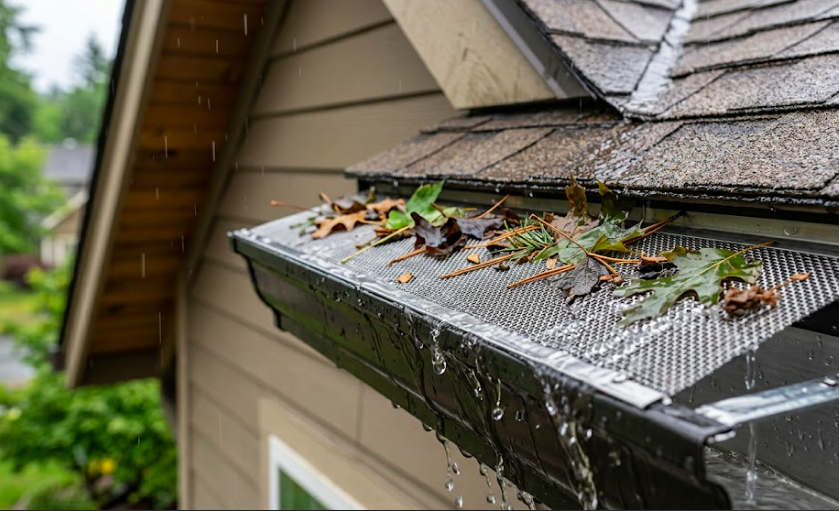
If you’ve searched do gutter guards work or are gutter guards worth it, you’ve probably noticed most answers focus on one thing: leaves. Gutter guard marketing is built almost entirely around clog prevention never clean your gutters again but that’s only half the story homeowners actually need.
The real question isn’t just whether gutter guards keep debris out. It’s whether they prevent the thing debris causes: water damage to your roof, fascia, foundation, and the inside of your home. And the honest answer is more nuanced than most gutter guard ads let on.
In this guide, we’ll break down exactly what gutter guards do prevent, what they don’t, where homeowners get a false sense of security, and when a clogged or poorly performing gutter system has already caused damage that guards alone can’t fix.
What Gutter Guards Actually Do
Gutter guards are covers or mesh inserts installed over your gutters to block leaves, pine needles, and larger debris from entering the channel while still allowing water to flow through. Most products fall into a few categories:
- Mesh and micro-mesh guards – fine screens that block even small debris like shingle grit and seed pods
- Reverse-curve (surface tension) guards – solid covers that use water’s surface tension to pull it into the gutter while debris slides off the edge
- Foam insert guards – porous foam that fills the gutter channel, letting water through while blocking debris
- Bottle-brush guards – bristled inserts that trap debris on top while water flows underneath
All of these are genuinely effective at one thing: reducing how often you need to physically clean leaves and debris out of your gutters. That part of the marketing is accurate.
Where Gutter Guards Fall Short on Water Damage Prevention
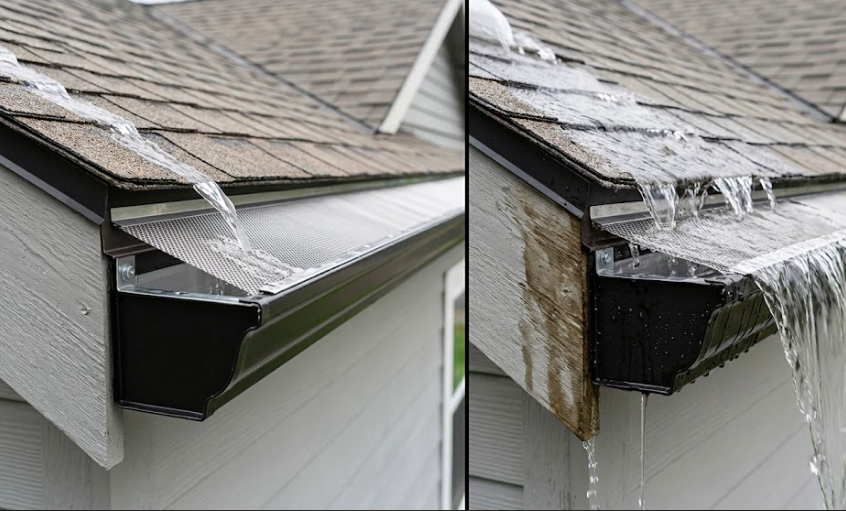
Here’s what most product pages won’t tell you clearly: gutter guards reduce clogging, but they don’t eliminate the water damage risks that clogging causes and they introduce a few new risks of their own.
1. They Don’t Fix Existing Pitch or Slope Problems
If your gutters already have incorrect slope not angled enough toward the downspouts water will pool and overflow regardless of whether debris is present. Gutter guards address what’s falling into the gutter, not how well the gutter itself is designed to move water out.
2. Fine Debris and Granules Still Get Through (or Build Up On Top)
Even high-quality micro-mesh guards can’t stop everything. Roof shingle granules, pollen, and fine silt can accumulate on the mesh surface over time, gradually restricting flow just more slowly than an uncovered gutter would clog. Homeowners often assume “guards installed” means maintenance-free, which leads to longer gaps between inspections and a false sense of security.
3. Ice and Snow Behave Differently With Guards Installed
In colder climates, some guard types particularly solid reverse-curve covers can actually contribute to ice dam formation by altering how water sheets off the roof edge. If you’re in a region with freeze-thaw cycles, this is worth discussing with an installer rather than assuming all guards perform the same in winter conditions.
4. They Don’t Address Downspout or Drainage Capacity
A clog-free gutter still needs somewhere for the water to go. If your downspouts are undersized, poorly placed too close to the foundation, or draining into an area with poor grading, gutter guards do nothing to solve that water will still pool near your home’s foundation even with a completely debris-free gutter system.
5. Improper Installation Can Create Water Intrusion Points
Guards that are installed incorrectly gapped, warped, or pitched the wrong way can actually direct water behind the gutter and toward the fascia board or roof edge instead of into the gutter channel. In these cases, a gutter guard installation mistake becomes a new source of water damage rather than a prevention measure.
So Are Gutter Guards Worth It?
Yes, with realistic expectations. Gutter guards are a genuinely valuable maintenance tool that reduces how often gutters need manual cleaning and lowers (but doesn’t eliminate) the risk of debris-caused overflow. According to the U.S. Department of Housing and Urban Development, regular gutter and downspout maintenance is one of the most cost-effective ways homeowners can prevent water infiltration and structural damage to a home’s foundation and exterior walls. Guards support that maintenance goal they don’t replace it.
Think of gutter guards as risk reduction, not risk elimination. They lower the odds of a debris-related overflow event, but they don’t correct slope issues, downspout drainage problems, or existing water damage that may have already occurred before installation.
How to Know If Water Damage Has Already Happened – Guards or No Guards
Whether or not you have gutter guards installed, it’s worth checking your home for signs that past gutter overflow or drainage issues have already caused damage:
- Fascia or soffit staining – brown or dark streaking along the roofline, often where water has repeatedly overflowed
- Peeling paint or bubbling near the roofline – a sign moisture has been sitting against exterior trim
- Soil erosion or pooling near the foundation – particularly within 3-5 feet of the house
- Basement or crawl space dampness – musty odors or visible moisture, especially after heavy rain
- Cracks in the foundation or exterior walls – near areas where gutters have historically overflowed
If any of these sound familiar, the issue likely predates or won’t be solved by gutter guard installation alone. According to FEMA, which is why catching early signs matters more than most homeowners realized.
When It’s More Than a Gutter Problem
Gutter guards, proper slope, and correct downspout placement can prevent future water damage. But if water has already made its way into your walls, foundation, crawl space, or basement, that’s no longer a prevention question it’s a restoration one.
If you’re noticing any of the signs above and you’re in the McAllen area, it’s worth having the damage professionally assessed before it spreads further or develops into mold. The team at water damage restoration McAllen specializes in exactly this identifying how far existing moisture has traveled, whether it’s reached structural materials, and what needs to be dried, repaired, or replaced. Fixing the gutter problem going forward is important, but it won’t undo damage that’s already occurred.
Our Recommendation
If you’re deciding whether to invest in gutter guards, do it as part of a complete system check not a standalone fix. Have your gutter slope, downspout placement, and drainage path evaluated at the same time as guard installation. Guards solve the debris problem; a properly pitched, well-draining system solves the water problem. You need both working together to actually reduce water damage risk.
Final Thoughts
Gutter guards are a worthwhile investment for reducing maintenance and lowering debris-related overflow risk but they’re not a complete water damage prevention solution on their own. Slope, drainage capacity, downspout placement, and installation quality all matter just as much, if not more. And if water damage has already occurred before guards were installed, no guard however well-made will reverse it.
Thinking about gutter guards or unsure if your current gutter system is actually protecting your home? Contact Clearwater Gutter Repair for a full gutter and drainage assessment, including slope, downspout placement, and guard recommendations tailored to your home.
Leave a Reply