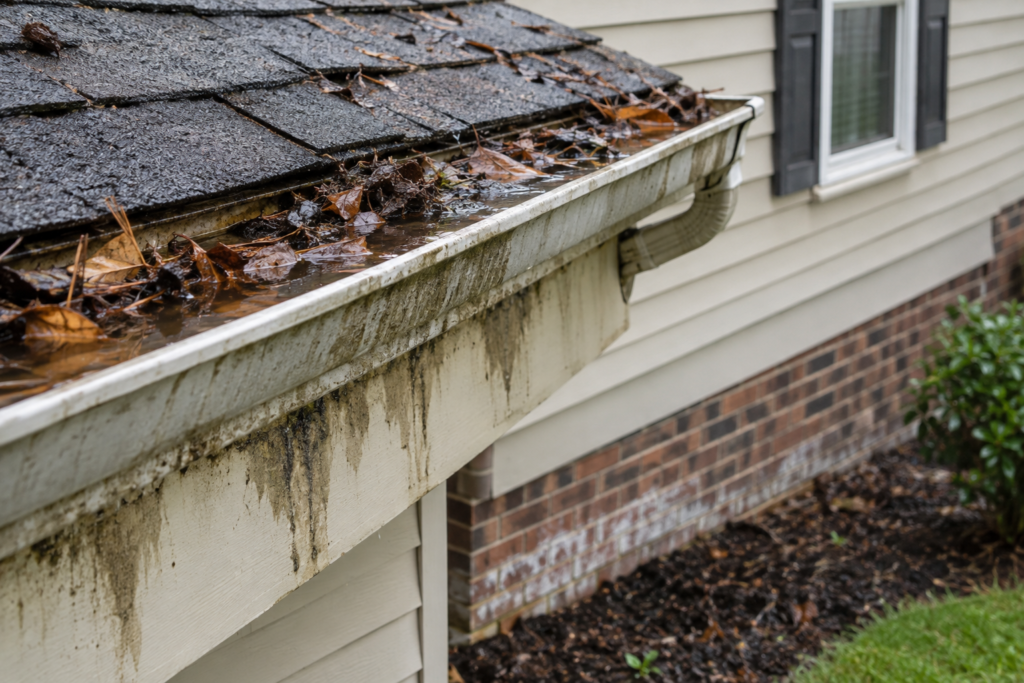
Most homeowners think of gutter problems as a nuisance a little overflow during heavy rain, maybe some staining on the siding. But here’s the reality: by the time gutters are visibly failing, the structural damage to your home may have already begun.
Water is patient. It doesn’t announce itself. It seeps into fascia boards, creeps behind siding, saturates soil around your foundation, and finds its way into basements and crawl spaces all while your gutters quietly clog or pull away from the roofline.
This guide covers the seven clearest signs that your gutters have already caused or are actively causing structural water damage to your home.
Why Gutters Matter More Than Most People Realize
Your gutter system is the first line of defense between your roof and your home’s structural envelope. A properly functioning gutter collects runoff from hundreds of square feet of roof surface and channels it away from the foundation.
When gutters fail through clogging, sagging, improper slope, or separation from the fascia that volume of water doesn’t disappear. It redirects into every vulnerable zone: behind siding, under roofing materials, into soffit cavities, and along the foundation perimeter.
According to the Insurance Information Institute, water damage and freezing account for nearly 29% of all homeowner insurance claims in the U.S. a large portion of which originates from preventable drainage failures at the roofline.
Sign #1: Paint Peeling or Bubbling on Exterior Walls
Exterior paint doesn’t bubble or peel randomly. When you see this happening near the roofline, under eaves, or on sections of siding adjacent to a downspout, it’s almost always a moisture intrusion signal.
Overflowing gutters push water behind fascia boards and siding. Once moisture gets trapped between the wall sheathing and the paint layer, the paint loses adhesion. Left unchecked, this progresses from a cosmetic issue to rotted sheathing and compromised wall framing.
What to check: Run your hand along the siding below the gutter line after a rainfall. Soft, spongy sections indicate water is already saturating the wall cavity.
Sign #2: Rotting or Stained Fascia Boards
The fascia board the long horizontal board your gutters are mounted to is typically made of wood, and wood and standing water don’t coexist well.
When gutters sag or pull away slightly from the fascia, water pools between the gutter back and the board. Over weeks and months, this causes:
- Dark staining and discoloration
- Soft, crumbling wood that dents under finger pressure
- Visible gaps between the gutter and the roofline
Rotted fascia is both a structural concern (gutters lose their anchoring) and a pest invitation carpenter ants and termites are strongly attracted to wet, decaying wood.
Sign #3: Foundation Cracks or Hydrostatic Pressure Signs
This is where gutter failure transitions from cosmetic damage into serious structural territory.
When downspouts discharge water at the base of the home or when gutters overflow and saturate the soil directly against the foundation two things happen:
- Soil expansion and contraction: from repeated wet/dry cycles puts lateral pressure on foundation walls, eventually causing hairline cracks that widen over time.
- Hydrostatic pressure: builds up as saturated soil pushes water into any available gap particularly in poured concrete or block foundations.
The American Society of Civil Engineers notes that a significant percentage of foundation failures in residential structures trace back to poor surface drainage and uncontrolled water runoff both of which are direct consequences of failed gutter systems.
Look for:
- Horizontal or stair-step cracks in block foundations
- Vertical cracks in poured concrete walls
- White chalky residue (efflorescence) on basement walls a clear sign water is migrating through the wall
Sign #4: Basement Flooding or Chronic Dampness
If your basement floods or smells musty after every significant rainfall, the cause is almost always surface water finding its way in and gutters are the primary suspect.
Water follows the path of least resistance. When your gutter system deposits hundreds of gallons of runoff directly against your home’s perimeter, that water saturates the soil, raises the water table locally, and migrates through basement walls and floor joints.
Many homeowners spend thousands on interior waterproofing systems (French drains, sump pumps) without fixing the root cause at the roofline. If your downspouts discharge within three feet of your foundation, that’s almost certainly contributing to your basement moisture problem.
Sign #5: Soffit Damage or Visible Mold Near the Roofline
The soffit is the underside of your roof overhang and it’s particularly vulnerable when gutters back up or overflow toward the roofline rather than away from it.
Backed-up gutters can push water upward under the first course of shingles, allowing it to wick into the roof deck and drip down into soffit cavities. Signs of this include:
- Dark staining on soffit panels
- Peeling or bubbling paint on the soffit
- Visible mold growth (often appearing as dark spotting)
- A musty odor near the eaves
Mold in soffit cavities is a serious issue spores can migrate into attic spaces and, from there, into living areas. For homes in humid climates, soffit mold from gutter backup can develop surprisingly fast after even one or two rain events.
Sign #6: Soil Erosion or “Moating” Around the Foundation
Walk around your home after a heavy rain and look at the ground directly beneath your gutters and downspout exits. What you should see: soil sloping away from the foundation with no standing water. What indicates a problem:
- Deep ruts or channels carved into the soil below the gutterline (from overflow cascading straight down)
- Pooling water or “moats” forming against the foundation
- Mulch or topsoil being washed away from landscaping beds
This erosion isn’t just a landscaping issue it gradually removes the compacted soil buffer between your foundation and surface water, accelerating infiltration.
Sign #7: Interior Water Stains on Ceilings or Upper Walls
This is the most alarming sign and typically indicates the damage has progressed beyond the gutter-fascia interface and into the roof structure itself.
When gutters back up severely particularly in winter when ice dams form meltwater can back up under shingles and penetrate the roof deck. The result: water stains on interior ceilings, often appearing as brown rings or expanding discoloration near exterior walls or in upper-floor rooms.
If you’re seeing interior staining, the gutter failure has almost certainly created secondary damage at the roof level. At that stage, you’re looking at not just gutter repair but potential roof deck replacement and interior remediation.
What to Do If You’re Seeing These Signs
If you’ve identified two or more of the signs above, your home likely has active water damage that needs professional assessment not just a gutter cleaning.
Step 1: Get the gutters inspected and repaired first. Fixing the water source is always the priority. If you need gutter repair or replacement, that’s the starting point for stopping ongoing damage.
Step 2: Assess the structural damage scope. A professional water damage restoration company can inspect the fascia, soffit, roof deck, basement, and crawl space to determine how far the damage has spread and what remediation is required.
For homeowners in northeast Ohio dealing with water intrusion, structural drying, or basement flooding linked to gutter failure, Akron OH Water Damage provides professional water damage restoration and structural drying services across the Akron metro area.
Step 3: Don’t delay remediation. Water damage that’s already penetrated wall cavities or framing members doesn’t stop on its own. The longer remediation is deferred, the higher the risk of mold colonization typically beginning within 24–72 hours of saturation in warm conditions, per FEMA’s flood damage guidance.
Preventing Gutter-Caused Water Damage: A Quick Checklist
| Task | Frequency |
|---|---|
| Clean gutters of leaves and debris | 2x per year (spring & fall) |
| Inspect gutter slope and alignment | Annually |
| Check downspout discharge distance from foundation | Annually |
| Inspect fascia and soffit for rot or staining | After every severe storm |
| Verify downspout extensions are intact | Before rainy season |
| Check basement walls for new staining or efflorescence | Seasonally |
Final Thought
Gutters are a maintenance item most homeowners chronically underestimate until the signs of structural damage make themselves impossible to ignore. The seven warning signs above aren’t hypothetical worst cases. They’re the predictable outcome of deferred gutter maintenance in most US climates.
If you’re concerned about your current gutter system’s condition, a professional inspection is the fastest way to know where you stand and the most cost-effective way to prevent a minor gutter problem from becoming a major restoration project.
Need gutter repair before water damage sets in? Get a free gutter repair estimate from our team – serving homeowners nationwide.
Leave a Reply