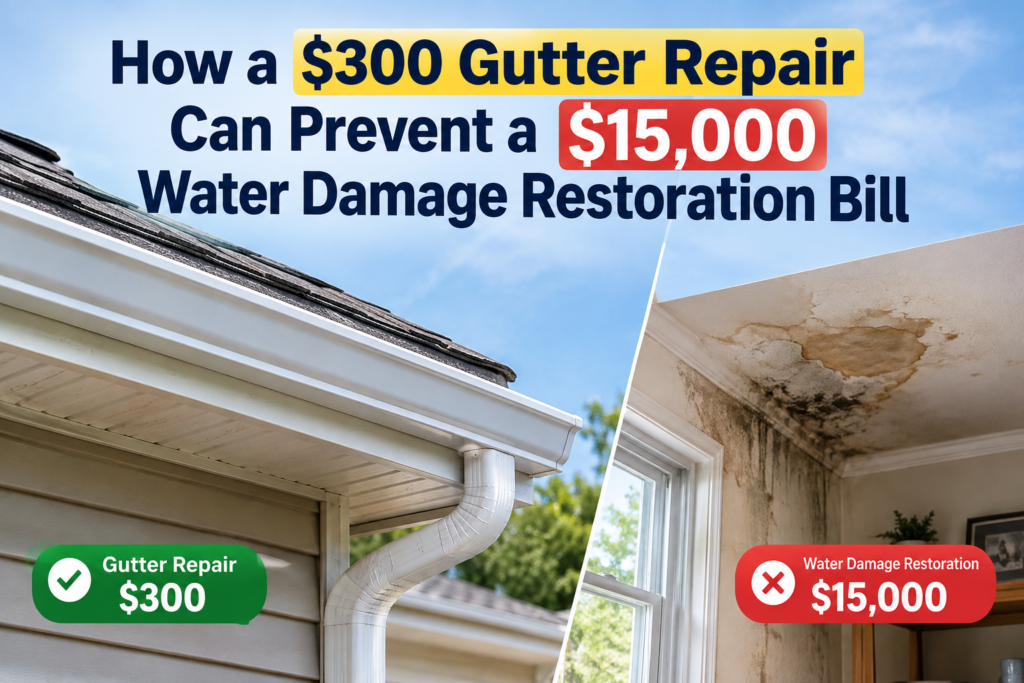
A sagging gutter section. A clogged downspout. A few separated seams after a hard winter. These are the kinds of repairs most homeowners put off not because they don’t know they should fix them, but because they don’t understand what happens if they don’t.
The numbers tell a stark story. A standard gutter repair resealing seams, reattaching loose sections, clearing a blocked downspout typically costs between $150 and $400. The average water damage restoration project, once water has breached a wall cavity and caused mold growth or structural damage, costs between $3,000 and $15,000. In severe cases involving foundation damage or widespread mold, that figure climbs higher.
This article breaks down exactly how an unaddressed $300 gutter problem becomes a $15,000 remediation job and what you can do to make sure that path never plays out in your home.
The Real Numbers: What Gutter Repairs and Water Damage Actually Cost
Gutter Repair Costs – What You’re Actually Paying For
Gutter repair is one of the most underpriced home maintenance services available. Here’s what typical repair work costs:
- Downspout unclogging and flushing: $75 – $150 per downspout
- Resealing gutter seams and end caps: $100 – $200 for a standard section
- Rehang and realign sagging gutters: $150 – $300 depending on linear footage
- Replace damaged 10-foot gutter section: $100 – $250 including labor
- Full gutter cleaning and inspection: $100 – $225 for a typical single-story home
Even at the high end, a full gutter service cleaning, inspection, seam sealing, and minor repairs rarely exceeds $400 for most homes. That’s the ceiling on prevention.
Water Damage Restoration Costs – What Neglect Actually Costs
Once water has entered a wall assembly, attic, or crawl space through a failed gutter system, the restoration cost depends on how long the moisture has been present and how far it has spread. According to Forbes Home’s water damage cost analysis, homeowners spend an average of $3,000 to $5,500 on water damage restoration but costs escalate sharply when structural materials are involved:
- Drywall removal and replacement: $350 – $900 per wall section
- Insulation removal and replacement: $1.50 – $4.50 per square foot
- Mold remediation (contained, single room): $1,500 – $4,000
- Mold remediation (multi-room or structural): $5,000 – $12,000+
- Structural wood framing replacement: $2,000 – $8,000 per affected wall
- Crawl space encapsulation after moisture intrusion: $3,000 – $8,000
- Foundation repair from long-term water pressure: $5,000 – $25,000+
The $15,000 figure in this article’s headline is not a worst-case outlier. It’s a realistic mid-range estimate for a home where gutter overflow has gone unaddressed for two or more years and reached the mold-plus-framing-damage stage.
How a $300 Problem Becomes a $15,000 Project: The Escalation Path
The cost doesn’t jump overnight. It builds in stages and each stage that passes without intervention makes the next stage more expensive to fix.
Step 1 – The Ignored Repair ($0 spent, problem begins)
A gutter seam separates or a downspout clogs after a storm. The homeowner notices water spilling over the gutter edge during heavy rain but attributes it to rain volume, not a gutter failure. No repair is made.
Step 2 – Fascia and Soffit Saturation (Repair cost still ~$300)
Over the next several rain events, water consistently overflows the same section and runs directly down the fascia board. The fascia begins absorbing moisture. A gutter repair at this stage reattaching the section, resealing the seam, possibly replacing one fascia board still costs under $400.
Step 3 – Wall Cavity Moisture Entry (Repair cost: $800 – $2,500)
Saturated fascia allows moisture to wick behind the siding. The wall cavity now has wet insulation. A contractor at this stage must repair the gutter, replace the fascia, and potentially open wall sections to dry insulation or replace it. The bill has now tripled to quintupled from the original repair cost.
Step 4 – Mold Colonization (Repair cost: $3,500 – $8,000)
Wet insulation and damp OSB sheathing provide ideal mold growth conditions. Mold colonies establish on wall framing within weeks of sustained moisture. At this stage, remediation requires removing finished surfaces, treating framing, replacing insulation, and repairing gutters as the source. This is where most homeowners first realize the scope of what’s happening and it’s already a five-figure problem.
Step 5 – Structural Framing Damage (Repair cost: $8,000 – $15,000+)
Wood rot has compromised one or more wall studs. Remediation now requires structural repair in addition to mold treatment, drywall replacement, insulation replacement, and gutter repair. The National Association of Home Builders reports that structural framing repairs are among the highest-cost remediation categories precisely because they require coordination between general contractors, remediation specialists, and in some cases, engineers.
The same $300 gutter repair, done at Step 2, stops this entire cascade.
Why Homeowners Wait – And Why That Logic Breaks Down
Most homeowners who delay gutter repairs aren’t being careless. They’re making what seems like a reasonable judgment call. Here’s why that reasoning fails:
- I’ll wait until I see real damage: The damage is occurring inside your wall cavity, where it’s invisible until it’s severe. By the time you see a stain on interior drywall, mold has typically been present for months.
- The rain hasn’t been that heavy: Gutter overflow causes damage through accumulated smaller events, not just major storms. Each inch of rain that overflows the same section adds moisture to the same fascia board.
- I’ll get to it in the spring: Freeze-thaw cycles in northern climates including Ohio actively accelerate water intrusion. Water that enters a wall cavity in fall freezes, expands, and forces seams wider over winter.
- Insurance will cover it: Most homeowner insurance policies explicitly exclude damage caused by lack of maintenance. Gutter neglect is one of the most commonly cited reasons for water damage claim denial.
What Insurance Won’t Tell You About Gutter-Related Water Damage
This is the detail that most homeowners discover too late: insurance coverage for water damage depends heavily on whether the damage was sudden and accidental, or gradual and preventable.
A burst pipe that floods a basement overnight is typically covered. Water damage that accumulated over months through a neglected gutter? Insurers classify this as maintenance neglect and it is routinely excluded from standard homeowner policies. That means the full cost of remediation falls to the homeowner out of pocket.
Certified remediation companies that follow IICRC restoration standards document the source and timeline of water intrusion as part of their assessment process. When that documentation shows a gutter as the source and the damage pattern shows gradual accumulation, insurers have a clear basis for denial.
The $300 gutter repair isn’t just cheaper than remediation – it’s the only version of this scenario that insurance doesn’t penalize.
When the Damage Has Already Started: What to Do Next
If you’re reading this and you’ve already noticed signs of water intrusion staining, soft drywall, musty odor, or visible mold the priority order changes. At that point, gutter repair is still necessary, but it’s no longer sufficient on its own.
The correct sequence is:
- Stop the source first: Have the gutter repaired or replaced to eliminate ongoing water entry. No remediation holds if the moisture source continues.
- Get a professional moisture assessment: A certified remediation team uses thermal imaging and moisture meters to map the full extent of intrusion without unnecessary wall openings.
- Follow the remediation protocol: Drying, material removal, antimicrobial treatment, and rebuild in that order. Skipping drying and moving straight to rebuild is the most common mistake homeowners make when attempting DIY remediation.
- Get documentation: A remediation company that provides a drying log and post-clearance report protects you if you need to make an insurance claim or sell the home.
For homeowners in the Akron area dealing with active or suspected water intrusion from failed gutters, reaching out to a team that provides certified water damage remediation is the right first call after the gutter source is addressed. A professional assessment will tell you exactly what you’re dealing with and whether the situation can be resolved before it escalates further.
The Gutter Maintenance Schedule That Prevents All of This
Preventing gutter-related water damage doesn’t require expensive upgrades or constant vigilance. It requires a consistent, minimal maintenance routine:
- Twice-yearly cleaning: Late spring and late fall. Clear all debris from gutters and flush downspouts with a garden hose. Note any sections where water pools instead of flowing.
- Post-storm inspection: After any storm with significant wind or debris, check that gutters are still attached and that downspouts are clear.
- Annual seam inspection: Look for separated seams, rust spots, or cracks at end caps. These are the first failure points and the cheapest to address.
- Check downspout discharge: Ensure all downspouts direct water at least 6 feet from the foundation. Splash blocks and extensions are inexpensive and prevent a major source of foundation moisture.
- Watch fascia condition: Peeling paint, soft wood, or visible rot on fascia boards is a direct indicator of overflow history. It’s also a sign that wall cavity moisture may already be present.
When repairs are needed, addressing them promptly is the only strategy that reliably prevents escalation. A reputable gutter repair service can assess the full condition of your system, identify failure points before they cause overflow, and make repairs that last at a cost that’s a small fraction of what remediation would run.
The Bottom Line
The $300 vs. $15,000 comparison in this article isn’t meant to alarm it’s meant to recalibrate how homeowners think about gutter maintenance. Gutters are not a cosmetic feature. They are a primary water management system for your home, and when they fail, water finds the path of least resistance directly into your building envelope.
The homeowners who end up with five-figure restoration bills are not the ones who had particularly bad luck. They’re the ones who delayed a repair they already knew was needed. The window between a $300 fix and a $15,000 project is measured in rain events, not years and every storm that hits a compromised gutter narrows that window further.
Schedule the repair. Get the inspection. The math is not complicated.
Leave a Reply