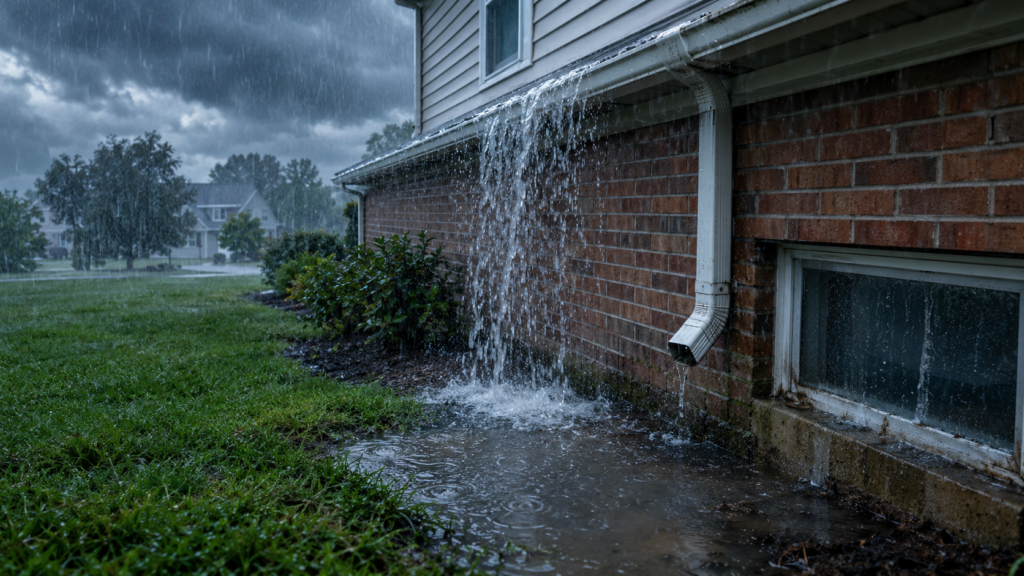
Your gutters and downspouts do more than manage rainwater they’re your home’s first line of defense against foundation damage and basement flooding. Yet most homeowners overlook them entirely until it’s too late. A single clogged elbow, a misaligned extension, or a downspout that terminates too close to the foundation can funnel hundreds of gallons of water directly into your basement during a heavy rainstorm.
In this guide, we’re breaking down the most critical downspout drainage mistakes homeowners make and how to fix them before they turn into a costly water damage emergency.
Why Downspout Drainage Matters More Than You Think
When it rains, your roof collects an enormous volume of water. A 1,500 sq. ft. roof during a 1-inch rainfall generates roughly 935 gallons of water. Your gutter system is supposed to channel all of that safely away from your home. When the system fails even partially that water has to go somewhere. And more often than not, it finds its way into your basement.
Foundation water intrusion is one of the leading causes of structural damage in American homes. According to the Insurance Information Institute (III), water damage and freezing account for a significant share of homeowner insurance claims each year and a large percentage of those claims trace back to poor exterior drainage.
Understanding the connection between your downspouts and your basement is the first step to protecting your home.
Mistake #1: Downspouts That Terminate Too Close to the Foundation
This is the single most common and most damaging downspout mistake homeowners make.
The problem: Building codes generally require downspout extensions to discharge water at least 6 feet away from the foundation. Many homes have downspouts that end right at the base of the house, or extensions that are too short to make a real difference.
What happens: When water pools near your foundation, it saturates the soil and creates hydrostatic pressure. Over time, this pressure pushes water through cracks in your basement walls and floor even hairline cracks that seem insignificant.
The fix:
- Install a splash block angled away from the house if you don’t have one
- Use flexible downspout extensions to direct water 6–10 feet from the foundation
- Consider underground piping that carries water to a designated drainage area in your yard
Mistake #2: Clogged or Blocked Downspouts
A downspout that’s full of leaves, twigs, or compacted debris doesn’t drain it overflows. And that overflow usually spills along the side of your house, straight toward your foundation.
The problem: Many homeowners clean their gutters but forget to flush their downspouts. A downspout can look clear from the top but have a blockage deep inside an elbow joint.
Signs your downspout is clogged:
- Water overflowing from the gutter near a downspout
- Slow or no discharge from the downspout outlet during rain
- Wet streaks or staining on your siding near downspouts
The fix:
- Flush downspouts with a garden hose at the beginning of each season
- Use a plumber’s snake to clear stubborn blockages in elbow joints
- Install downspout strainers or leaf guards at the top to prevent debris entry
- Schedule professional gutter cleaning at least twice a year more if you have heavy tree coverage
Mistake #3: Improper Slope and Grading Around the Home
Even a perfectly functioning gutter system can fail if the ground around your home isn’t properly graded. This is a landscaping issue that directly impacts your downspouts’ effectiveness.
The problem: The soil around your foundation should slope away from the house at a grade of at least 1 inch per foot for the first 6 feet. If your yard is flat or slopes toward the house, water from your downspouts (and rain in general) will pool against your foundation.
What happens: Flat or negative grading creates a “bathtub effect” where water collects right where you don’t want it against your basement walls. Even with properly extended downspouts, if the ground funnels water back toward the foundation, you’ll still have flooding problems.
The fix:
- Have a landscaping professional assess and correct your yard’s grading
- Add topsoil around the foundation perimeter and slope it away from the house
- Consider French drains or a swale system if your property has persistent low spots
Mistake #4: Disconnected or Leaking Downspout Joints
Downspouts are assembled from multiple sections. Over time, joints can separate due to wind, settling, ice expansion, or simple wear. A loose joint can leak hundreds of gallons directly against your foundation before you even notice it.
The problem: Disconnected sections often go unnoticed because the top portion of the downspout still looks intact. The water simply leaks out mid-way down, right next to your house.
How to spot it:
- Inspect all downspout joints after a rainstorm look for drips or wet spots at the connections
- Check for rust or staining on siding at joint locations
- Walk around your home during rain to watch for unexpected water streams
The fix:
- Reconnect loose joints and secure them with sheet metal screws
- Seal joints with gutter sealant or caulk rated for exterior use
- Replace corroded or damaged sections entirely don’t patch metal that’s already failing
Mistake #5: Too Few Downspouts for Your Roof Size
Gutters can only move water as fast as your downspouts allow. If you don’t have enough downspout capacity, your gutters will overflow during heavy rain even if they’re completely clean and unobstructed.
The problem: A common rule of thumb is one downspout per 30–40 linear feet of gutter. Many older homes were built with fewer downspouts than needed, or with downspouts that are too narrow (2″x3″ instead of the preferred 3″x4″) for the roof’s square footage.
The fix:
- Have a gutter professional evaluate your system’s capacity relative to your roof size
- Add downspouts if your gutters regularly overflow during moderate-to-heavy rain
- Upgrade to larger 3″x4″ downspouts if you have significant roof area or live in a high-rainfall region
Mistake #6: Downspouts That Drain Into Window Wells or Low-Lying Areas
Some homeowners direct their downspout extensions toward window wells, low spots in their yard, or areas near basement egress points thinking they’re sending water “away” from the house. This is a serious mistake.
The problem: Window wells that fill with water will eventually leak into the basement. Low-lying areas that collect downspout discharge can become saturated and push water back toward the foundation through soil absorption.
The fix:
- Never direct downspouts toward window wells, basement stairwells, or low-lying areas adjacent to the home
- Use underground drain pipes connected to your downspout to carry water to the street or a designated dry well
- Install window well covers as an additional layer of protection
Mistake #7: Ignoring Downspout Drainage in Winter
In cold climates, downspout neglect during winter months can cause ice dams and freeze-thaw cycles that crack and disconnect your drainage system setting you up for flooding when spring arrives.
The problem: Water that collects in a clogged downspout will freeze, expand, and force joints apart. When the ice melts in spring, you have a compromised system right when rainfall is heaviest.
The fix:
- Clean and flush downspouts before the first freeze each year
- Consider heated downspout cables in regions with heavy ice accumulation
- Inspect your entire system in early spring before rainy season begins
What to Do If Your Basement Has Already Flooded
If you’ve already experienced basement flooding whether from downspout drainage issues or another cause time is critical. Standing water and moisture that sits for more than 24–48 hours creates ideal conditions for mold growth, structural damage, and health hazards.
Immediate steps:
- Identify and stop the water source if it’s still active
- Document the damage with photos for your insurance claim
- Contact a professional water damage restoration company as quickly as possible
For homeowners in South Texas dealing with flooding, mold, or water intrusion, the team at McAllen TX Water Damage Restoration provides 24/7 emergency services including water extraction, drying, and full structural restoration. Don’t wait; fast action is the difference between a manageable repair and a major rebuild.
How to Build a Downspout Drainage System That Actually Works
A reliable system combines several elements working together:
| Component | Purpose | Recommended Spec |
|---|---|---|
| Gutter size | Collect roof runoff | 5″ (standard) or 6″ (heavy rainfall areas) |
| Downspout size | Move water efficiently | 3″x4″ rectangular or 4″ round |
| Downspout spacing | Prevent gutter overflow | Every 30–40 ft of gutter |
| Extension length | Protect foundation | Minimum 6 ft from foundation |
| Yard grading | Direct water away | 1″ drop per foot for first 6 ft |
| Splash blocks | Disperse discharge | Angled away from house |
For a deeper dive into gutter sizing standards and water management best practices, the Federal Emergency Management Agency (FEMA) Homeowner’s Guide to Retrofitting offers excellent resources on protecting your home from water intrusion at the source.
When to Call a Professional Gutter Company
While some downspout maintenance is DIY-friendly, certain situations call for a professional evaluation:
- Your gutters overflow during every moderate rainstorm despite being clean
- You’ve had basement flooding more than once
- Your home is more than 20 years old and has never had its gutter system assessed
- You notice foundation cracks, efflorescence (white mineral deposits) on basement walls, or musty odors all signs of ongoing moisture intrusion
- You’re planning a landscaping project that could affect grading and drainage
Professional gutter and drainage companies have the tools to assess your entire system from the gutters themselves to the grade of your yard and can recommend targeted fixes that DIY efforts often miss.
For more guidance on gutter systems and exterior drainage solutions including professional repair and installation services visit Clear Water Gutter Repair to explore how a properly maintained gutter system protects your home year-round.
Final Thoughts: Small Fixes, Major Protection
Downspout drainage issues are among the most preventable causes of basement flooding yet they’re consistently overlooked until significant damage has occurred. The good news? Most of the mistakes covered in this guide are fixable for a few hundred dollars or less. Compare that to the average basement water damage restoration cost, which can run from $2,500 to $10,000+ depending on severity, and the ROI on proper gutter maintenance becomes crystal clear.
Walk around your home after the next rainstorm. Watch where your downspouts are discharging, check your joints for leaks, and make sure water is moving decisively away from your foundation. These few minutes of observation can save you from a much bigger headache down the road.
Have questions about water damage, mold remediation, or emergency restoration services in the Rio Grande Valley? Visit McAllen TX Water Damage Restoration or call for a free consultation – available 24/7 for emergency response.
Leave a Reply